



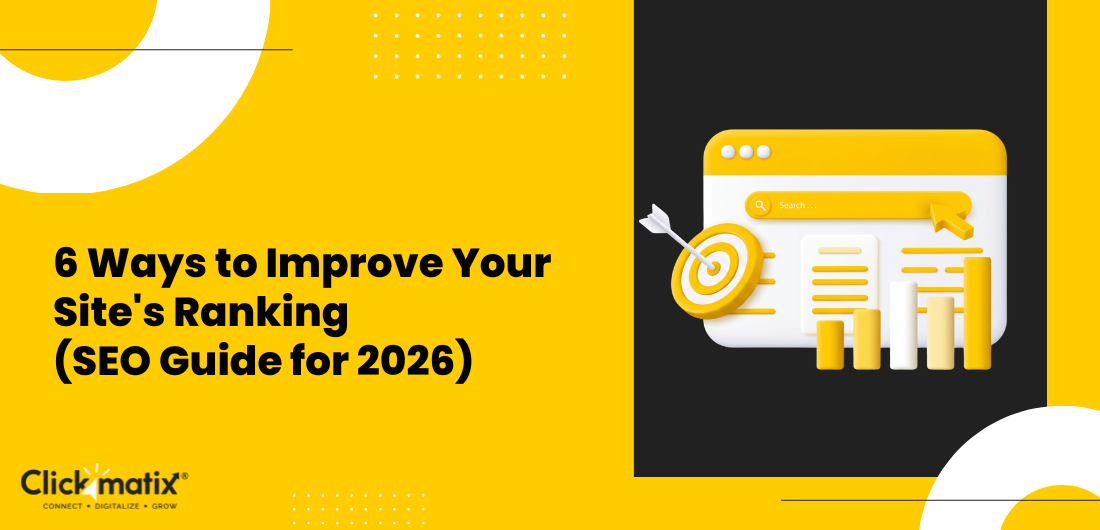



In 2026, showing up on the first page of Google is not merely a nice-to-have. It’s the difference between a thriving business and one that’s invisible online. Studies consistently show that the top three organic results capture the majority of all clicks, making rankings a direct driver of leads and revenue.
Unlike paid ads, which stop delivering the moment your budget runs out, organic traffic built through SEO compounds over time. Understanding how to improve website ranking on Google means addressing what Google actually measures: content relevance, backlinks, user experience, page speed, and mobile usability.
This guide walks you through six proven ways to improve website ranking in 2026.
What Affects Your Google Ranking?
Google’s algorithm evaluates hundreds of signals before deciding where your page appears in search results. At its core, the system is designed to reward pages that are genuinely useful, trustworthy, and technically sound.
The key ranking signals include:
- Content relevance: Does your page answer what the user searched for?
- Backlinks: Do reputable websites link to your content?
- User experience: Do visitors stay, engage, and convert?
- Page speed: Does your site load quickly across all devices?
- Mobile usability: Is your site fully functional on smartphones?
Improving your ranking means systematically addressing each of these signals. Let’s break down exactly how.
Way #1: Optimise Your On-Page SEO
On-page SEO optimisation tips form the foundation of any successful strategy. This is what you control directly, and where small changes can deliver meaningful improvements fast.
Improve Title Tags & Meta Descriptions
Your title tag is the first thing users see in search results. Include your primary keyword, ideally near the beginning, and keep it under 60 characters.
Meta descriptions don’t directly affect rankings, but they drive click-through rates. Write them to summarise the page’s value in under 155 characters and include a gentle call to action.
Use Proper Heading Structure (H1-H3)
Google uses headings to understand the structure and hierarchy of your content. Use one H1 per page, H2s for major sections, and H3s for supporting points. A clear heading structure improves both readability and crawlability.
Keyword Optimisation Best Practices
Keyword stuffing is penalised by Google and harms readability. Instead, use your target keyword naturally, complement it with semantic variations, and focus on covering a topic thoroughly rather than repeating a phrase artificially.
Way #2: Create High-Quality SEO Content
Content remains the single most powerful lever in SEO, but it must match what users actually want to find.
Write Content That Matches Search Intent
Informational queries need educational content; transactional queries need product or service pages. Aligning your content format to search intent is critical to both ranking and converting visitors.
Use Long-Tail Keywords Strategically
Phrases like “how to improve Google ranking fast for small business” are less competitive and convert better than broad terms. Weave them naturally into headings, body copy, and FAQs.
Improve Content Depth & Authority
Comprehensive content that answers a user’s question thoroughly consistently outranks thin, surface-level pages. Go deep: include data, examples, step-by-step guidance, and FAQs. The latter increases your chances of appearing in Google’s featured snippets, giving you prime visibility above the standard results.
Way #3: Improve Technical SEO
Technical SEO ensures Google can crawl, understand, and index your site correctly. Even great content will struggle to rank if your site has underlying technical issues.
Improve Website Speed
Core Web Vitals, covering loading speed (LCP), interactivity (INP), and visual stability (CLS), directly influence rankings. Compress images, minify code, enable caching, and use a CDN to hit Google’s performance thresholds.
Mobile Optimisation
Google uses mobile-first indexing, meaning it ranks your site based on its mobile version. If your site isn’t fully responsive, your rankings will reflect it. Test regularly with Google’s Mobile-Friendly Test.
Fix Crawl Errors & Indexing Issues
Google Search Console reveals crawl errors, indexing gaps, and manual penalties. Audit it regularly and submit updated sitemaps to keep your site in good standing with Google’s crawler.
Way #4: Build High-Quality Backlinks
Backlinks are one of the most powerful ranking signals in Google’s algorithm, functioning as votes of confidence from other sites.
What Are Quality Backlinks in SEO?
A backlink from a respected industry publication carries far more weight than dozens of links from low-quality directories. Google evaluates not just the quantity but the quality, relevance, and diversity of your backlink profile.
White-Hat Link Building Strategies
Focus on guest posting on reputable blogs, digital PR (creating data-driven content journalists want to cite), and listings in high-quality industry directories.
Avoid Toxic Backlinks
Links from spammy or penalised sites hurt your rankings. Audit your backlink profile regularly and use Google’s Disavow Tool to remove harmful associations.
Way #5: Improve User Experience (UX SEO)
Google uses behavioural signals as a proxy for quality. A site that frustrates users won’t hold its rankings for long.

Get weekly insights for revenue-shifting results
Sign up for our newsletter and be the first one to know about our exclusive offers, digital marketing news and updates.


Reduce Bounce Rate
Match content to search intent, write short paragraphs and break up text with clear headings, and ensure fast load times. A strong first impression keeps users on the page.
Improve Page Engagement
Internal linking helps users find their way on your site and distributes link authority across your domain. Guide them on where to go next with clear calls to action.
Improve Navigation & Site Structure
Use a logical hierarchy, keep important pages within three clicks of the homepage, and use descriptive, keyword-rich URLs to create an SEO-friendly architecture.
Way #6: Optimise for Local SEO (If Applicable)
For location-based businesses, understanding key SEO ranking factors is one of the fastest ways to improve SEO performance and attract nearby customers through effective local SEO strategies.
Google Business Profile Optimisation
Claim and fully complete your Google Business Profile. Provide details for name, address, phone, hours, services, and photos. Actively gather reviews; positive ratings boost local pack visibility and signal activity to Google.
Local Keyword Targeting
Incorporate location-specific keywords throughout your website, such as city names, suburb references, and “near me” variations, to capture high-intent local searches.
Local Citations & Listings
Keep your Name, Address, and Phone number (NAP) consistent across all directories. This includes Google, Yellow Pages, TrueLocal, and niche listings. Inconsistent NAP erodes local ranking trust signals.
SEO Ranking Factors You Should Monitor
Keep a regular eye on these core indicators of your site’s SEO health:
- Domain authority: Review how strong your backlinks are
- Page speed: Check your scores for mobile and desktop
- Content freshness: Are your main service pages regularly updated and reviewed?
- Backlink quality: Are you gaining links from relevant, reputable sources?
Common SEO Mistakes That Hurt Your Rankings
Here are the common pitfalls that are going to trip you up if you’re not careful:
- Keyword stuffing: Don’t overload your text with keywords, as it disrupts readability and triggers Google penalties
- Duplicate content: Identical or near-identical content across multiple pages confuses Google about which to rank
- Ignoring mobile optimisation: With mobile-first indexing, an unresponsive site is a ranking liability
- Poor internal linking: Failing to link related content leaves pages isolated and underperforming
SEO Checklist for Better Rankings (Quick Summary)
On-page SEO done ✔
Technical SEO fixed ✔
Backlinks built ✔
UX improved ✔
Content updated regularly ✔
Conclusion
Understanding how to rank higher on Google search isn’t about shortcuts; it’s about building a site that genuinely earns its position. Combine strong content, solid technical SEO, legitimate backlinks, and a great user experience, and the growth you achieve will be durable.
Ready to grow your organic presence online?
At Clickmatix, we help businesses of all sizes build SEO strategies that deliver real, measurable results. If you’re ready to improve your rankings and grow your organic presence, our team is here to help.
Contact us at 1300 159 314 and get a free quote today.
FAQs
How long does SEO take to improve rankings?
Most businesses see meaningful improvements within 3 to 6 months, though competitive niches or newer sites may take 6 to 12 months. SEO compounds over time; the longer you invest, the stronger the returns.
What is the fastest way to improve Google ranking?
Quick wins come from on-page fixes (title tags, meta descriptions, heading structure), improving page speed, and resolving Search Console errors. For local businesses, optimising your Google Business Profile delivers fast visibility gains.
Do backlinks still matter for SEO in 2026?
Yes, backlinks remain a top-three ranking signal. Quality beats quantity every time. A few links from authoritative, relevant sites are worth far more than hundreds of low-quality ones.
How often should I update my website for SEO?
Review core service pages every six months and publish fresh blog content regularly. Consistent updates signal to Google that your site is active and authoritative.
In search for strategic sessions?
Let us understand your business thoroughly and help you
strategies your digital product.

It's time to call your business-
a brand!
 Australian Owned Agency
 Save Time and Money
 Unbeatable Value
 Where Work Gets Done
free Ecommerce SEO guide for Higher Sales & Conversion

THE ULTIMATE MARKETING GUIDE FOR LAWYERS

Youtube Ads Guide How to Advertise on Youtube
free Ecommerce SEO guide for Higher Sales & Conversion
It's time to call your business-
a brand!
- Australian Owned Agency
- Save Time and Money
- Unbeatable Value
- Where Work Gets Done


The Game-Changing Ecommerce SEO Guide That Will Blow Your Mind & Sales
With this Ecommerce SEO Guide, you'll be able to:
- Develop a Ecommerce SEO strategy.
- Build a content marketing strategy that aligns with your business goals.
- Convert your website visitors into paying customers.

Youtube ads guide how to advertise on youtube
With this Youtube ads Guide, you'll be able to:
- Develop a Youtube ads strategy.
- Build a type of ads of your own that aligns with your business goals.
- Generate revenue from youtube ads.
It's time to call your business-
a brand!
- Australian Owned Agency
- Save Time and Money
- Unbeatable Value
- Where Work Gets Done