



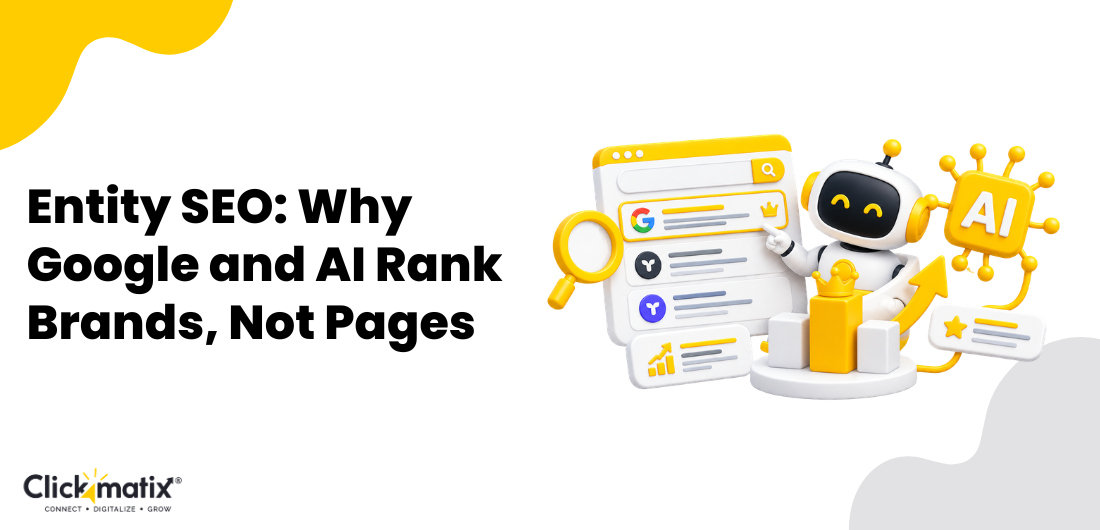



Search has moved beyond simply matching keywords to pages. Modern search systems increasingly try to understand people, businesses, products, services and the relationships between them. For businesses, this means SEO is not only about optimising individual URLs. It is also about making the business itself clear and consistent across its digital presence.
This is where entity SEO comes in. It helps search systems understand who a business is, what it offers, who it serves, and what it is known for.
This guide explains what entity SEO means, why Google is moving beyond keyword matching, how AI search changes visibility, the key pillars of entity SEO, and how businesses can build a stronger digital presence.
What Is Entity SEO?
An entity is a recognisable person, business, organisation, product, or concept that search systems can understand beyond a single keyword.
Traditional SEO often focuses on matching keywords to specific pages. Entity SEO takes a broader approach by connecting a business with its services, location, industry, expertise, and related topics.
For example, a search system should understand not only that a company provides SEO services, but also who the company is, where it operates, what it specialises in, and what information supports its expertise.
Entity SEO does not replace keyword research, search intent or technical SEO. Instead, it complements page-level optimisation by strengthening the wider context around a business.
Why Google Is Moving Beyond Keyword Matching
Modern search systems look at the meaning and context behind a search instead of relying only on exact keyword matches. A page does not always need to use the exact words in a query if the content answers what the person is actually looking for.
This makes semantic relevance more important. Instead of creating a separate page for every keyword variation, businesses can cover a topic properly with useful content that addresses what their audience wants to know.
Google’s AI search experiences also use its existing search and quality systems to identify relevant information, meaning traditional SEO fundamentals remain important.
Google Doesn’t Just Evaluate a Single Page
Page-level relevance still matters, but a business’s wider digital presence can provide additional context.
A strong SEO strategy should help establish:
- Brand identity
- Expertise
- Authority
- Trust
- Topical relevance
- Business legitimacy
Google’s guidance focuses on helpful, reliable, people-first content. This means the pages on a website should support the same areas of expertise, rather than each page working as a separate SEO asset.
A service page can explain what a business offers, while blogs, case studies, and About information can provide additional evidence of its knowledge and experience.
What Changes With AI Search?
Traditional search generally presents a list of results for a query. AI experiences such as AI Overviews and AI Mode can synthesise information from multiple sources to produce a broader response.
Google has described a query fan-out approach, where AI search can perform multiple related searches to explore different aspects of a user’s question.
This makes it useful for businesses to have clear, connected information across their website and other credible sources. A brand consistently associated with a particular service, topic, or area of expertise has a broader digital footprint for search systems to understand.
Brand Recognition Is Becoming an SEO Asset
A strong and consistent online presence can help connect your brand with:
- Brand → service
- Brand → location
- Brand → expertise
- Brand → industry
- Brand → products or services
Branded searches, business information, and credible mentions can all contribute to this broader ecosystem. However, brand mentions alone should not be treated as a direct Google ranking factor.
Businesses should keep important information consistent across their website, Google Business Profile, relevant directories, and legitimate online properties.
The Difference Between Page Authority and Entity Authority
Page authority refers to the strength and relevance of an individual URL.
Entity authority looks at how clearly and consistently a business is understood across its wider digital presence.
For example:
- Service page: explains the service
- Blog: demonstrates expertise
- About page: establishes the business
- Case study: demonstrates experience
- Third-party mention: provides external recognition
These assets should reinforce the same underlying expertise rather than operating independently.

Get weekly insights for revenue-shifting results
Sign up for our newsletter and be the first one to know about our exclusive offers, digital marketing news and updates.


How AI Systems Decide Which Brands to Reference
AI search systems retrieve and synthesise information from available sources. This makes basic technical accessibility important. Content should be crawlable, indexable, clearly written, and supported by authoritative information.
Google does not require special AI markup to appear in AI Overviews or AI Mode. Its current guidance states that standard SEO practices remain relevant to its generative AI search features.
Structured data can help search engines understand page content, but it is not a shortcut to AI rankings. Similarly, Google states that llms.txt is not required for Google Search and does not positively or negatively affect search visibility or rankings.
The 7 Pillars of Entity SEO
1. Clear Brand Identity
Make sure your brand name, business description, About section, contact information, and overall branding are consistent across the various digital properties your business has.
2. Strong Topical Authority
Create content around the areas your business knows best. Supporting content should add useful depth to these topics, not target unrelated keywords.
3. Consistent Business Information
Keep business details accurate across your website, Google Business Profile, relevant directories, listings, and social profiles.
4. Structured Data
Add Organisation, Local Business, Person, Product or Service structured data when it fits the page. It gives search engines useful details about the page, but it does not guarantee higher rankings.
5. Internal Linking and Content Relationships
Connect related services, guides, case studies, and other pages where they fit naturally. Use relevant internal links with clear anchor text.
6. First-Hand Experience and Original Content
Use case studies, original research, client examples, expert insights, data, and your own observations to show what your business knows from experience.
7. External Recognition
Look for recognition from relevant industry publications, expert contributions, quality backlinks, and genuine brand mentions. Do not create mentions just to influence search systems.
Entity SEO vs Traditional Keyword SEO
Entity SEO and traditional SEO should work together.
| Traditional SEO | Entity SEO |
| Keyword targeting | Brand and topic associations |
| Search intent | Broader topical relevance |
| Page optimisation | Connected website ecosystem |
| Internal linking | Relationships between topics |
| Backlinks | External recognition |
| Structured content | Structured data |
| Organic visibility | Broader search visibility |
The goal is not to abandon keyword optimisation, but to connect individual pages with the business and expertise behind them.
A Practical Entity SEO Strategy for Businesses
Businesses can start by:
- Defining the core business entity.
- Mapping its main services, products, and topics.
- Auditing existing website content.
- Strengthening About and service pages.
- Creating supporting topical content.
- Adding appropriate structured data.
- Improving internal linking.
- Building relevant external authority.
- Monitoring branded and non-branded visibility.
Common Entity SEO Mistakes to Avoid
Avoid creating large volumes of low-value content simply to capture keywords. Other common mistakes include:
- Publishing unrelated articles
- Treating every keyword as a separate page
- Inconsistent business information
- Weak About or author information
- Overusing structured data
- Creating artificial brand mentions
- Focusing only on search volume
- Assuming llms.txt automatically improves AI visibility
Google’s guidance cautions against creating large amounts of content primarily to manipulate rankings or AI responses.
How to Measure Entity SEO Performance
Useful metrics can include:
- Branded search impressions and queries
- Non-branded organic visibility
- Topical keyword coverage
- Relevant service visibility
- Referring domains
- Quality brand mentions
- Organic traffic
- Leads and conversions
- AI search visibility and citations where measurable
The Future of SEO Is About Becoming the Answer, Not Just Ranking a URL
Google still relies on pages, crawling, indexing, and the basic principles of traditional SEO. Entity SEO is based on these fundamentals by making the business, its expertise, and its relationship to a topic clearer within the wider digital ecosystem.
The objective is not simply to rank one page for one keyword. It is to build a consistent, credible digital presence that search systems can understand and users can trust.
Want Your Brand to Become the Go-To Answer in Your Field?
Clickmatix uses its traditional search expertise and entity-building AI strategies to help businesses build a stronger digital presence across search engines. Call 1300 159 314 to discuss your SEO strategy with our team and learn how we can improve your search visibility.
FAQs About Entity SEO
What is entity SEO?
Entity SEO helps search systems understand a business, person, product or concept and its relationships with relevant topics, services and information.
Is entity SEO replacing traditional SEO?
No. Entity SEO complements traditional SEO. Keyword research, search intent, technical SEO and page optimisation remain important.
How does Google understand a brand as an entity?
Google can use information from a website and other sources to understand organisations, people, products and their relationships. Consistent, useful information provides clearer context.
Does entity SEO help with AI Overviews?
Entity SEO can support the broader SEO foundation used for AI search experiences, but no technique guarantees inclusion in AI Overviews.
Does structured data improve entity SEO?
Structured data can help Google understand page content, but it is not a shortcut to rankings or AI visibility. It should accurately represent the content on the page.
In search for strategic sessions?
Let us understand your business thoroughly and help you
strategies your digital product.

It's time to call your business-
a brand!
 Australian Owned Agency
 Save Time and Money
 Unbeatable Value
 Where Work Gets Done
free Ecommerce SEO guide for Higher Sales & Conversion
THE ULTIMATE MARKETING GUIDE FOR LAWYERS

Youtube Ads Guide How to Advertise on Youtube
free Ecommerce SEO guide for Higher Sales & Conversion
It's time to call your business-
a brand!
- Australian Owned Agency
- Save Time and Money
- Unbeatable Value
- Where Work Gets Done


The Game-Changing Ecommerce SEO Guide That Will Blow Your Mind & Sales
With this Ecommerce SEO Guide, you'll be able to:
- Develop a Ecommerce SEO strategy.
- Build a content marketing strategy that aligns with your business goals.
- Convert your website visitors into paying customers.
Youtube ads guide how to advertise on youtube
With this Youtube ads Guide, you'll be able to:
- Develop a Youtube ads strategy.
- Build a type of ads of your own that aligns with your business goals.
- Generate revenue from youtube ads.
It's time to call your business-
a brand!
- Australian Owned Agency
- Save Time and Money
- Unbeatable Value
- Where Work Gets Done