





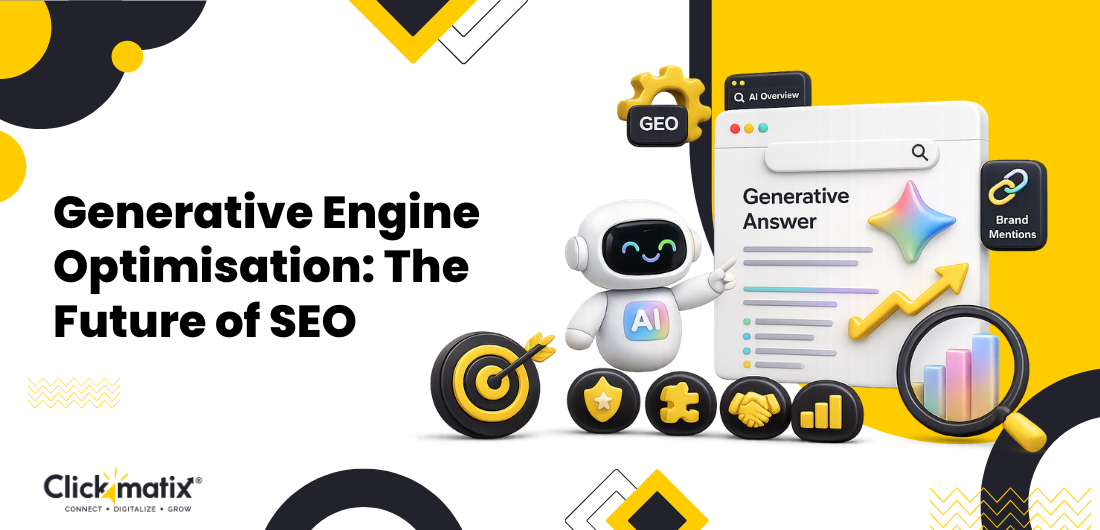



Search engine optimisation has never stood still. From the early days of keyword stuffing to mobile-first indexing and now intent-driven content, SEO has constantly evolved in response to how people search and how technology interprets those searches.
Today, SEO is going through a major shift. Generative AI tools like ChatGPT, Google’s AI Overviews, Perplexity, and Microsoft Copilot are fundamentally changing how users find and consume information online. Rather than typing a query into a search bar and sifting through ten blue links, users are receiving fully synthesised, conversational answers generated in real time.
For digital marketers, this raises a question of how visibility itself works. If search engines are generating answers instead of listing links, then how do you get included in those answers?
This is where generative engine optimisation (GEO) comes into the picture. Understanding how it works is crucial to navigating the AI-powered search landscape of tomorrow.
So, let’s get into it.
What is Generative Engine Optimisation (GEO)?
At its core, generative engine optimisation is the practice of optimising your content, website, and digital presence to be cited, referenced, and recommended by AI-powered search engines and large language models (LLMs).
Traditional SEO is built around helping search engines like Google understand and rank your pages so users can find them in search results. GEO takes a different approach. Instead of competing for a position on a results page, you’re competing to become the source that an AI engine draws on when it constructs its answer.
Think of it this way: when a user asks Google’s AI Overview “What’s the best digital marketing agency in Melbourne?”, Google isn’t just ranking pages; it’s synthesising an answer. GEO is about making sure your brand, expertise, and content are part of that synthesis.
You Might Also Like: SEO Checklist for 2026
How does GEO differ from traditional SEO?
Traditional SEO prioritises technical signals, such as backlinks, keyword density, page speed, and metadata. GEO, by contrast, prioritises relevance, authority, and clarity of meaning. It’s less about where your page ranks and more about whether the AI engine trusts your content enough to cite it or use it as the basis for a generated response.
Examples of generative engines include:
- Google AI Overviews: Google’s AI-generated summaries that appear above organic results
- Perplexity AI: An AI-native search engine that cites sources in real time
- Microsoft Copilot (Bing): A conversational search assistant integrated into the Bing ecosystem
- ChatGPT with Browse: OpenAI’s tool that searches the web to provide sourced answers
- Claude by Anthropic: Used increasingly for research and content discovery
Each of these tools relies on indexed content from the web, meaning that what you publish still matters, but how you publish it matters more than ever.
How Generative AI is Changing Search
-
From Keywords to Intent
Traditional search was a matching exercise. You typed in a keyword, the search engine matched it to indexed pages, and the most authoritative pages rose to the top. Keyword strategy was, for a long time, the heart of SEO.
Generative AI changes the equation entirely. These engines are built to understand intent, not just words. A user asking “how do I get more customers without spending a fortune on ads?” isn’t using any of the obvious digital marketing keywords. But a generative engine understands exactly what they need and will surface relevant content accordingly.
This means that content written to satisfy human curiosity and answer real questions will perform better than content engineered purely for keyword density.
-
Personalisation at Scale
AI-powered search is beginning to deliver genuinely personalised experiences at a scale previously unattainable. Search engines are getting better at understanding context, including your location, search history, the phrasing of your query, and even the device you’re using, and adjusting results accordingly.
For businesses, this means generic content is becoming less effective. Content that speaks to specific audiences, answers nuanced questions, and demonstrates genuine expertise is what AI engines are increasingly likely to surface.
-
The Rise of AI-Driven SERPs
Google’s AI Overviews, launched widely in 2024, signalled a new era for search results pages. For many queries, users now see a generated summary at the very top, before any organic results. Click-through rates to traditional blue links dropped significantly for queries where AI Overviews appeared.
This is a fundamental structural change. Zero-click searches are becoming more common. Visibility is no longer just about ranking on page one; it’s about being the source that the AI engine draws from when it generates that top-of-page answer.
You Might Also Like: Local SEO strategies
Key Components of GEO
-
Content Generation: Quality Over Quantity
AI engines are trained to identify high-quality, authoritative content. For generative engine optimisation, this means creating content that goes beyond surface-level information and genuinely demonstrates expertise.
Content needs to be comprehensive, well-structured, and genuinely useful. It should answer the full scope of a question, not just the obvious part. Long-form content that explores a topic from multiple angles tends to perform well because it provides the depth that AI engines can draw on when crafting detailed answers.
AI writing tools can accelerate this process, but they work best as a starting point. Human expertise, original data, and genuine perspective are what differentiate content that gets cited from content that gets ignored.
-
Semantic Understanding: Meaning Over Keywords
GEO requires optimising for meaning and context rather than specific keyword phrases. This means using natural, conversational language that reflects how people actually ask questions, including related terms, synonyms, and topic clusters that signal to an AI engine that your content is comprehensive.
Semantic SEO has been growing in importance for years, but generative engine optimisation takes it to the next level. Entities (people, places, organisations, concepts) and the relationships between them matter enormously. Content that clearly explains concepts, defines terms, and establishes relationships between ideas is inherently more useful to an AI engine.

Get weekly insights for revenue-shifting results
Sign up for our newsletter and be the first one to know about our exclusive offers, digital marketing news and updates.


-
User Experience Signals
Engagement metrics remain critical. AI engines don’t exist in isolation; Google still watches how users interact with content once they land on it. High dwell time, low bounce rates, scroll depth, and interaction signals all tell the algorithm that your content is genuinely useful.
This is one area where GEO and traditional SEO fully align: a great user experience is always rewarded.
-
Structured Data and Schema Markup
Schema markup helps AI engines understand the structure and meaning of your content. Marking up your content with relevant schema types, like FAQ schema, How-To schema, Article schema, and Local Business schema, makes it far easier for a generative engine to extract and use the information you’ve published.
For businesses looking to implement generative engine optimisation effectively, structured data is one of the highest-leverage technical investments you can make right now.
Strategies for Implementing GEO
-
Use AI to Research Intent and Generate Content
AI tools can help you identify the kinds of questions your target audience is actually asking, in the language they use. Tools like Perplexity, ChatGPT, and Google’s “People Also Ask” feature provide rich insights into the full range of intent around a topic.
Use this research to build content that comprehensively addresses a topic. Not just its primary keyword, but the surrounding questions, objections, and sub-topics that real users care about.
-
Optimise for Conversational Queries and Voice Search
Generative AI is inherently conversational. Users interacting with AI-powered search often phrase their queries as full questions or natural sentences. Optimising for this means structuring content with clear question-and-answer formats, using natural language, and anticipating follow-up questions.
Voice search amplifies this further. Voice queries tend to be longer, more conversational, and more locally specific. Content that mirrors how people speak, rather than how they type shorthand queries, is better positioned for both voice and generative search.
-
Integrate AI Insights into Your Broader Strategy
Generative engine optimisation isn’t a replacement for a comprehensive digital marketing strategy; it’s an additional dimension. AI-generated insights should feed into your keyword strategy, content calendar, internal linking structure, and technical SEO priorities.
At Clickmatix, we help businesses integrate these insights into a cohesive strategy that improves performance across both traditional and AI-powered search channels.
-
Balance AI and Human Expertise
The most effective content in an AI-driven search environment is human-led and AI-assisted. AI tools can handle research, outlines, first drafts, and optimisation suggestions. Human expertise adds original thinking, brand voice, ethical judgement, and the kind of nuanced perspective that readers and AI engines alike recognise as genuinely authoritative.
The sweet spot is a workflow where AI accelerates production without replacing the human insight that gives content its credibility.
Challenges and Considerations
-
The Risk of Low-Quality AI Content
Not all AI-generated content performs well in an AI-driven search environment. Google’s Helpful Content guidelines explicitly target content that is generated primarily for search engines rather than for people. If your GEO strategy relies on mass-producing AI content without genuine quality control, you risk penalties rather than performance gains.
The standard for content quality is rising, not falling, in the age of generative AI, precisely because there’s so much more content being produced.
-
Maintaining Brand Voice and Authenticity
One of the most common pitfalls in AI-assisted content is losing the brand voice that makes a business distinctive. Audiences are increasingly good at recognising generic AI output, and trust is built on authenticity. Any content produced under a GEO strategy should sound like your brand, reflect your values, and carry your point of view.
-
Ethical Considerations
AI content generation raises real questions about transparency, accuracy, and intellectual property. Businesses should be thoughtful about disclosing AI involvement where appropriate, rigorously fact-checking AI-generated claims, and ensuring their content doesn’t inadvertently reproduce or misrepresent others’ work.
Ethical use of AI in content creation isn’t just the right thing to do; it protects your brand’s long-term reputation and trustworthiness.
The Future of SEO with Generative Engines
-
Where AI-Driven Search is Heading
The direction is clear: AI will play an increasingly central role in how search engines understand and present information. Google, Microsoft, and a growing cohort of AI-native search engines are all investing heavily in generative capabilities. Within the next few years, the majority of complex search queries are likely to be answered, at least partially, by AI-generated responses.
This doesn’t mean traditional SEO is dead. It means the goalpost has moved. Ranking well remains important, but being cited as a trusted source by generative engines is becoming equally valuable.
-
Early Adoption Creates Lasting Advantage
As with every major shift in SEO, the businesses that adapt early gain disproportionate advantages. Those who understood the value of content marketing before it became standard practice, who optimised for mobile before Google made it a ranking factor, and who built E-E-A-T signals before they were formalised, are the ones who pulled ahead and maintained that lead.
The same opportunity exists now with generative engine optimisation. The strategies and content assets you build today will position your business as an authoritative source that AI engines learn to trust and consistently reference.
-
Hybrid Strategies are the New Standard
The future of SEO isn’t a choice between traditional optimisation and GEO; it’s the intelligent combination of both. Technical SEO, high-quality backlinks, and on-page optimisation still matter. Layer on top of that a commitment to semantic content, structured data, E-E-A-T signals, and conversational query optimisation, and you have a strategy that performs across both traditional and generative search environments.
Conclusion
The search landscape is being rewritten in real time. Generative AI is no longer a future consideration; it’s shaping how your potential customers find information right now. Generative engine optimisation is the framework that helps you stay visible, credible, and competitive in this new environment.
For marketers and business owners, the message is simple: the time to start experimenting with GEO is now. Build content with depth and authority. Structure it so AI engines can understand it. Back it with genuine expertise. And make sure your brand is positioned as a trusted source that generative engines naturally turn to.
The businesses that take these steps today won’t just survive the AI revolution in search; they’ll lead it.
Ready to future-proof your SEO strategy?
At Clickmatix, we help Australian businesses navigate the rapidly evolving search landscape, from traditional SEO and PPC through to AI-driven digital marketing strategies. Whether you’re just starting to think about GEO or ready to overhaul your entire content approach, our team is here to help.
Get in touch with Clickmatix at 1300 159 314 today, and let’s build a search strategy that works for the future of AI-powered search.
In search for strategic sessions?
Let us understand your business thoroughly and help you
strategies your digital product.


It's time to call your business-
a brand!
 Australian Owned Agency
 Save Time and Money
 Unbeatable Value
 Where Work Gets Done

free Ecommerce SEO guide for Higher Sales & Conversion

THE ULTIMATE MARKETING GUIDE FOR LAWYERS

Youtube Ads Guide How to Advertise on Youtube
free Ecommerce SEO guide for Higher Sales & Conversion
It's time to call your business-
a brand!
- Australian Owned Agency
- Save Time and Money
- Unbeatable Value
- Where Work Gets Done



The Game-Changing Ecommerce SEO Guide That Will Blow Your Mind & Sales
With this Ecommerce SEO Guide, you'll be able to:
- Develop a Ecommerce SEO strategy.
- Build a content marketing strategy that aligns with your business goals.
- Convert your website visitors into paying customers.

Youtube ads guide how to advertise on youtube
With this Youtube ads Guide, you'll be able to:
- Develop a Youtube ads strategy.
- Build a type of ads of your own that aligns with your business goals.
- Generate revenue from youtube ads.
It's time to call your business-
a brand!
- Australian Owned Agency
- Save Time and Money
- Unbeatable Value
- Where Work Gets Done